Queer Survival on the Margins and Community Bonds
My Tender MatadorQueer Survival on the Margins and Community Bonds describes a life built amid poverty, social exclusion, gender policing, and political danger, but not reducible to them. The Queen of the Corner makes a home and a livelihood through skill, performance, and fragile relationships with other queer people; community care sustains her, even as scarcity and rivalry can turn that care into conflict. Her marginal identity also becomes a means of moving through the streets and checkpoints of Santiago during dictatorship, bringing intimate survival into direct contact with political resistance.
Social Marginality and Self-Presentation
The Queen arrives in a lower-class Santiago neighborhood as an openly effeminate newcomer, drawn to an earthquake-damaged house that has stood boarded up for years. She clears it out and makes it habitable, singing old songs as neighbors watch from their windows. Her singing becomes the neighborhood’s morning alarm, and the residents come to accept her as part of their social world despite their awareness that she is different. The welcome is conditional and observant: the same neighborhood that listens to her songs also trades political news at its grocery store, making the Queen’s home life inseparable from a community living under strain.
Gender presentation is not simply an outward sign of identity in this world; it is also a way to respond to danger. In a later encounter with soldiers dividing passengers into men’s and women’s lines, the Queen turns the demand into a joke about having to split herself in two. She speaks confidently about embroidery work for military families, using a respectable occupation and a knowing, flirtatious performance to deflect scrutiny. The scene shows both the pressure imposed by rigid gender categories and the quick social judgment needed to get past them. Her wit creates a moment of room to maneuver, but she remains aware that she is being watched and that the danger around her is real.
Survival, Work, and the Making of a Home
Before she has a home of her own, the Queen survives through street hustling, finding brief relief from cold and hardship in encounters that do not offer lasting security. Her account of childhood traces that precarity to earlier losses and abuse: her mother died when she was young, and her father responded to her femininity with punishment and attempts to force her into a masculine role. He rejected a teacher’s suggestion that she see a psychologist and instead believed the military could change her. At eighteen, she left home rather than submit to that future, and did not see him again. Her later independence is therefore not a simple escape into freedom; it follows a childhood in which home itself meant rejection and threat.
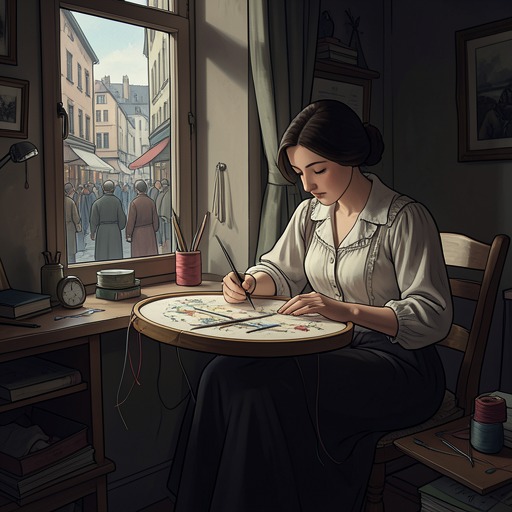
Rana becomes an alternative source of shelter and practical care. When the Queen is down-and-out, Rana takes her in, feeds her, urges her to avoid alcohol and drugs, and gives her clean clothes. She also teaches her embroidery, insisting that the Queen can learn by watching even though she can barely write. The Queen quickly becomes skilled at cross-stitch, running stitch, and fill stitch. Orders from upscale shops and wealthy families give her a better-paid livelihood, turning needlework into a route away from the street and toward the independent home that defines her new life.
That change carries a cost for the relationship that made it possible. As the Queen’s designs improve, Rana’s former clients begin seeking the younger woman’s more meticulous work, while Rana’s eyesight is failing. Rana sees the transfer of clients as betrayal after having housed, fed, and trained her. Their dispute exposes how economic precarity can place gratitude, care, and competition in tension: the Queen’s success offers her independence, but it also threatens the livelihood of the person who helped create it.
Community Bonds, Conflict, and Reconciliation
The Queen’s relationship with Rana is part of a wider network of queer companionship. Rana shares a house in Recoleta with Lupe and Fabiola; Lupe performs in drag as Carmen Miranda, while Rana and Fabiola, both retired from street work, remain connected to the informal economy. Their home is poor and plainly furnished, but the women have one another, and their teasing carries the familiarity of long acquaintance. They make room for the Queen’s visits and talk with her about Carlos, offering companionship even when their advice about her unreturned feelings is unwelcome.
The quarrel over embroidery becomes physical: Rana accuses the Queen of taking advantage of her and drives her out. The rupture lasts for months, but the Queen eventually returns with pastries, approaching Rana humbly rather than pretending nothing happened. Rana lets her in. The reconciliation does not erase the violence or the grievance; it shows that their bond has outlasted both. The Queen’s return to the house and renewed visits to her friends also make visible a form of kinship organized through shared history and mutual dependence rather than biological family.
Political Danger and Acts of Solidarity
The Queen’s home becomes connected to political resistance when Carlos and other men use it for meetings and leave boxes there. At first, the Queen sees Carlos’s visits through the lens of love, waiting awake while meetings continue and longing for signs of affection that he does not give. But the boxes and the men’s gatherings have a purpose beyond her romance. When a radio bulletin reports that security forces have seized weapons and leaflets associated with the Manuel Rodríguez Patriotic Front, she realizes that Carlos has kept her uninformed about the danger surrounding her own home.
Even so, the Queen acts on his behalf. During a demonstration, she carries a heavy package through tear gas and police violence, briefly fearing it has been lost when it slips under the bus seats. Once she finds it, she continues to the designated store and hands it to a waiting man. Her action is driven by attachment to Carlos, but its consequences are political: she has become a participant in a clandestine operation, exposed to repression without being told the whole story. On the journey back, she faces soldiers, uses her quick performance to avoid a search, and worries that returning home could expose both herself and Carlos. The resourcefulness that helps her pass through the checkpoint cannot make the house safe.
Displacement and Chosen Kinship
When the Queen leaves Santiago, she brings belongings and unfinished embroidery to Rana, asking her to keep the things and complete the work for extra money. She also leaves Rana her radio and tells her to use whatever else she needs. The request converts past conflict into present trust: Rana is again being asked to help preserve the Queen’s livelihood, this time during an urgent departure. The Queen will not explain the full circumstances, but insists that she must go because it is a matter of life and death.
Rana tries to stop her and asks why she is leaving, but the car horn interrupts them. The Queen loosens Rana’s grip, embraces and kisses her, and calls her Mama Rana. Rana watches her go, still unable to make sense of the departure. Their farewell gives the idea of community a concrete and bittersweet shape: care does not depend on complete knowledge, and affection persists even when danger forces separation. Across the Queen’s life, survival comes neither from safety nor from uncomplicated solidarity, but from the work of making shelter, earning a living, performing under scrutiny, and returning to people whose bonds have survived hardship and rupture.